Phew, what a busy month! May 2025 was action packed with several events going on most weekends. In this stuffed bat group newsletter we have lots to report on!
- Reports from all our Bat Box checks and Big Bat Counts.
- Updated dates and more sessions for our build a bat detector workshops.
- Can you help with??? Requests to the bat group.
- Lots of batty events coming up.
- Could you help the University of Bristol understand Antimicrobial use in Wildlife?
- Ex libris Dave Cottle – Batty books in return for donations to the group.
- The latest BCT Bat Group Bulletin includes news that the National Bat Monitoring Programme’s Annual Report has just been published.
- Welcome our new lifetime members!
- For people who joined in 2024 your membership has now lapsed, time for many to renew!
Bat Group event reports
Fri 9th May – Ruggin Bat Box Checks
Cath was leading on these checks, and reports: “We checked four boxes that are located close to Ruggin Nature Reserve on the Blackdowns. These boxes hadn’t been checked since the early 2000-teens. Unfortunately no bats were present.”
Sat 10th May – Gt.Breach and Ham Wall bat box checks
Josh led a group around these two sites and said: “We had a successful visit to a few sites around the Somerset Levels. Beginning at Great Breach Woods, unusually we had none of our Soprano Pipistrelle residents, but two boxes each with colonies of more than 15 Natterer’s bats. Afterwards we went down to Ham Wall for some lunch in the sun, surrounded by extensive wetlands, and spent the afternoon looking at Soprano Pipistrelle bats in many of the boxes there.”
Sat 10th May – Shepton Beauchamp Big Bat Count
A clear still night saw around 25 people in 8 teams set off to survey the night skies of Shepton Beauchamp. Our thanks to Jeff from the Cowleaze Meadow community group for organising and hosting.
A total of 62 bat observations were made across 7 Species on the night. The Common Pipistrelle was most commonly seen, but there were lots of observations of Noctule and Serotine.
Initial unverified observations from the night of 2nd May 2025 are in iNaturalist:


The bat recordings made on the night, and stored on the tablets, have now been analysed, and there are an extra 94 verifiable bat recordings uploaded to iNaturalist across 8 species,
Common Pipistrelle was the most frequently recorded, then Serotine, Soprano (Pygmy) Pipistrelle and Noctule The single faint recordings of the two Myotis species Daubenton’s and whiskered, along with those of the rare Lesser Noctule (Leisler’s) and Western Barbastelle will need more validation.
- 8 Verifiable species recording at the Shepton Beauchamp Big Bat Count 10th May 2025
- Bat map of the 94 verifiable bat recordings from Big Bat Count 10/5/25
- Validated “Research Grade” bat records
Sun 11th May – Harridge Bat Box Checks
Amber was leading on a sunny day in Harridge and reports: “A small team set off to find a lot of birds nests in the round boxes. It was nice to see a Soprano Pipistrelles in the flat 1FF boxes, along with a nice clustered group of brown long-eared at the end of the day. As always it was good to see a Lesser Horseshoe in the Keepers Cottage bat house. Thank you to everyone who came out, it was a good day to be fighting through the undergrowth!


Fri 16th May – Highbridge Big Bat Count


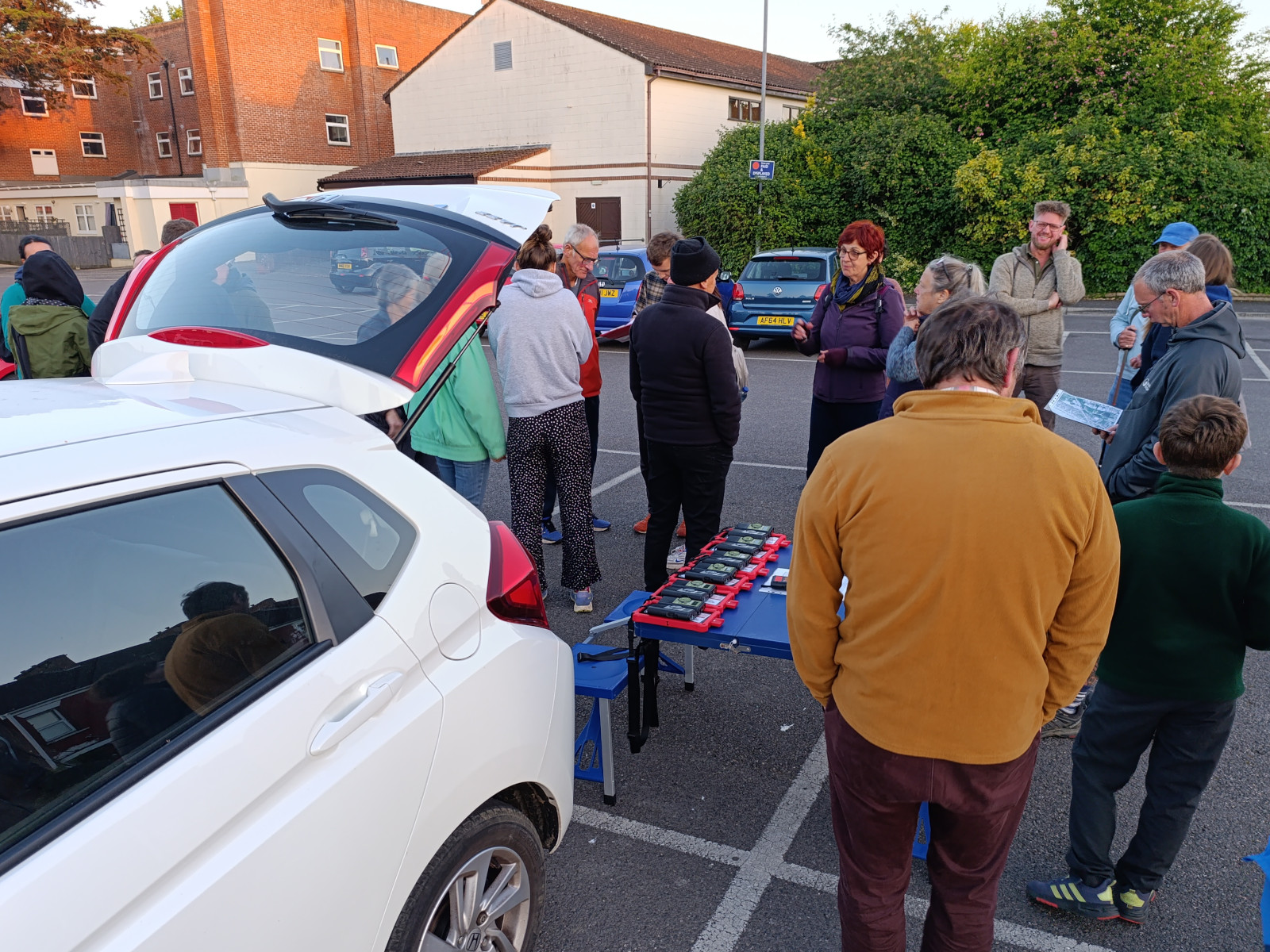
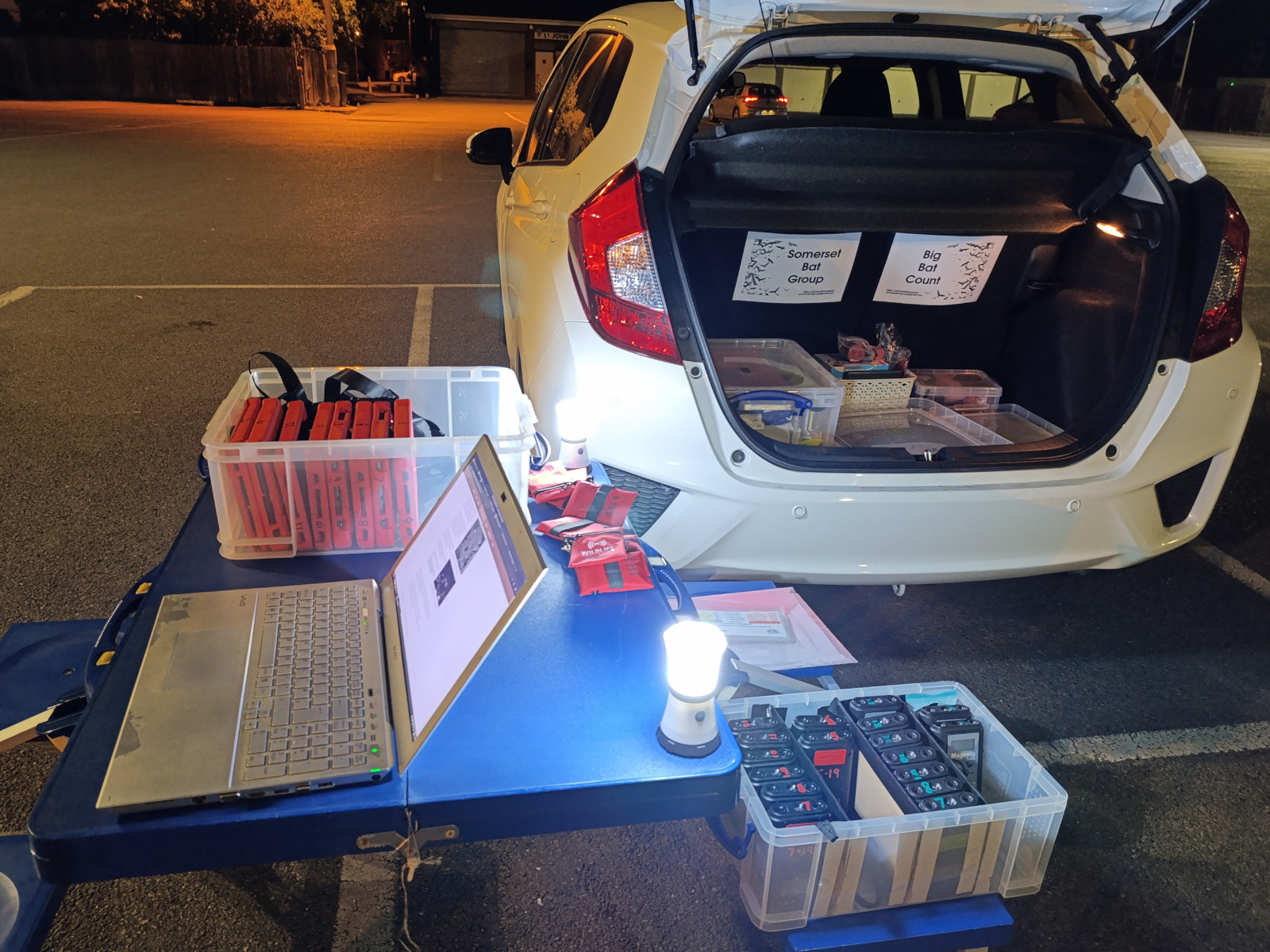
Around 25 people met in Bank Street car park under a clear sky, but with a cold wind blowing. Learning the lesson from last year the 4 teams started 1/2 hour after sunset as fortunately the wind started to drop.
A total of 87 bat observations were made across 5 Species on the night. With the Soprano (Pygmy) and Common and Pipistrelle making the bulk of the observations alongside a handful of Noctules.
Initial unverified observations from the night of 16th May 2025 are in iNaturalist:
The bat recordings made on the night, and stored on the tablets, have now been analysed, and there are an extra 67 verifiable bat recordings uploaded to iNaturalist across 5 species,
Common Pipistrelle and Soprano (Pygmy) Pipistrelle were by far and away the most frequently recorded. The single recordings of Noctule, Daubenton’s and Nathusius’ Pipistrelle around Apex will need more validation.
- 5 Verifiable species recording at the Highbridge Big Bat Count 16th May 2025
- Bat map of the 67 verifiable bat recordings from Big Bat Count 16/5/25
- Validated “Research Grade” bat records
Sat 17th May – East Mendips bat box checks
Josh reports: “We went over towards the Mendips – Kings Castle Wood and Withial Combe. Unfortunately we didn’t find any bats during these checks, though we could see that the boxes had clearly been used recently, many containing bat droppings.”
Sat 17th May – Bridgwater Big Bat Count
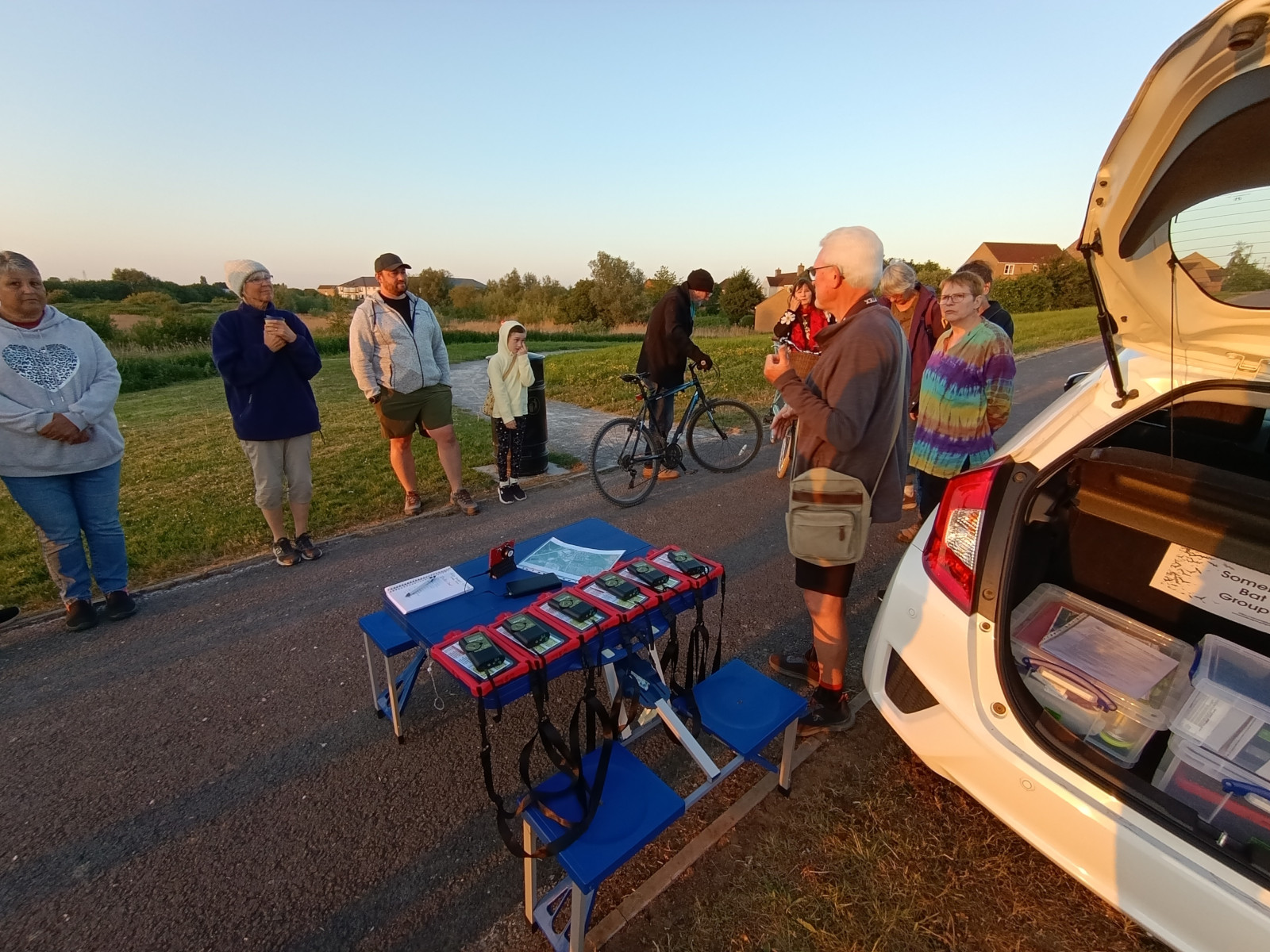
It was lovely to return to Wilstock Country Park for our second count there. Our thanks to Roger for organising again. Under a still cloudless sky around 25 people in 4 teams set off to survey the bats coming out of the housing around the park.
A total of 47 bat observations were made across 6 Species on the night. With the Common and Soprano (Pygmy) and being the most frequently observed. Last year’s verified record of a Leisler’s (Lesser Noctule) was repeated with another, as yet unverified, observation.

The bat recordings made on the night, and stored on the tablets, have now been analysed, and there are an extra 38 verifiable bat recordings uploaded to iNaturalist from species,
Common Pipistrelle and Soprano (Pygmy) Pipistrelle the most frequently recorded. With a single recording of Nathusius’ Pipistrelle at the far western end, which will need more validation.
- 3 Verifiable species recording at the Bridgwater Big Bat Count 17th May 2025
- Bat map of the 38 verifiable bat recordings from Big Bat Count 17/5/25
- Validated “Research Grade” bat records
Fri 23rd May – Thurlbear Wood Bat Box Checks
Cath said “A small group of people searched and checked nine out of eleven boxes in Thurlbear. Most of the boxes had no signs of bats at all and were in dense foliage- it proved impossible or dangerous to get to two of the boxes! It is likely that the boxes will be moved later this year into some of the Woodland glades where they are more likely to be occupied.”
more Build your own Bat Detector Workshops
Our Bat Detector building workshops have been booking up fast. So we have now added some extra sessions:
Sat 14th June 2025 – Somerset Earth Science Centre
- Morning: 10:30 AM to 12:30 PM (full). Afternoon 1:30 to 3:30PM (1 space)
- Moons Hill Quarry, Stoke St Michael, Radstock, Somerset BA3 5JU
- Venue hire fee = £5 per person building a detector
- email to ask about booking a place: somersetbatgroup@gmail.com.
Sat 5th July – Avalon Marshes Centre
- Morning session: 10AM to noon (FULL). New afternoon session: 1 to 3PM
- Avalon Marshes Centre, Shapwick Road, Westhay, Glastonbury, Somerset, BA6 9TT
- Booking is via the Somerset Wildlife Trust website.
SAT 19th July – SWT Taunton (new date)
- 10AM to noon
- Somerset Wildlife Trust Offices, 34 Wellington Rd, Taunton. TA1 5AW
- Booking will be via the Somerset Wildlife Trust website shortly.
Click here for full details of how the workshops work, and what amazing detectors you can build.
CAN YOU HELP WITH …?
The bat group receives far more requests for help than the committee can do. Hence please get in touch with the contact below if you think you could help out with this recent request:
- Glastonbury Abbey will be hosting seven Monday evening bat walks for groups of the public around Glastonbury Abbey, led by Abbey wildlife volunteers accompanied by a staff member. The Abbey are loaning a set of the groups detectors for this.
The dates for the bat walks are: 16th June*, 23rd June, 7th July, 14th July, 11th Aug, 18th Aug, 8th Sept and 15th Sept. *the first being staff/Abbey members only.
The Abbey would love experienced members along to help – email Anton for details, and to offer to assist.
2025 Bat group Events
Come along and get involved! The next events coming up are:
- June – NBMP Roost surveys
- 7June – Berrow Big Bat Count
- 14June – Bat Detector Building workshops – Stoke St Michael
- July – NBMP Field surveys
- 5July – Bat Detector Building workshops – Levels
- 19July – Bat Detector Building workshop – Taunton
- 25July – Ham Hill Big Bat Count
- Late July/early Aug – GLE Trapping and radio tracking
Details of how to get involved for all events are on the website: https://somersetbat.group/events/
Antimicrobial Use in Wildlife
Daniela Losada Medina a Researcher, from the University of Bristol sent us the following information:
“As part of a team of researchers at the University of Bristol, I am conducting a survey that aims to understand the use of antimicrobials and antimicrobial alternatives in wild animals admitted to wildlife rehabilitation centres in the British Isles.
We plan to achieve this by recruiting wildlife rehabilitators and/or veterinary professionals (veterinarians or registered veterinary nurses) who work with wild animals in these islands.
By saying wildlife rehabilitation centres, we also refer to wildlife rescues, wildlife hospitals and wildlife carers, no matter the size!
We are hoping to reach as many wildlife rehabilitators and veterinary professionals as possible who might be interested in filling out the survey, so I was wondering if this email could be shared with those in your team. I really value your help and do not hesitate to contact me if you have any questions.
Please find below more information about the survey:
Why is this survey important?
Research on antimicrobial resistance (AMR) in wild animals has mostly focused on free-ranging wild animals, while AMR at wildlife rehabilitation centres remains an understudied subject. The use of antimicrobials in humans and food-producing animals is one of the driving factors of AMR emergence. However, antimicrobial use in wild animals is still poorly understood.
What will I have to do?
You will be asked to complete a survey that will take between 15 to 45 minutes to complete. You will have the option to save the survey and complete it at a later time if you wish. The survey will remain open until September 30th, 2025.
If you are interested, please fill out the survey here: https://app.onlinesurveys.jisc.ac.uk/s/svs/survey-on-antimicrobial-use-wildlife-rehabilitation
Feel free to share this information with anyone who might be interested in filling out the survey.
We greatly value the perceptions and knowledge of wildlife rehabilitators and veterinary professionals, and we would truly appreciate their participation.”
ex libris Dave Cottle
We still have some bat books from the collection of Dave Cottle. All listed below are still available, in return for a donation to the bat group. Please email us ASAP, if you would like to reserve anything:
Hardback books (by publication date)
- Hedgehogs – Pat Morris – 1983
- The Lives of Bats – Wilfred Schober – 1984
- Bats – Phil Richardson (signed copy) – 1985
- A Guide to Bats of Britain and Europe – Wilfried Schober & Eckard Grimmberger – 1989
- Bats, a world of science and mystery – M.Brock Fenton & Nancy B Simmons – 2014
- Bat Calls of Britain and Europe – Jon Russ – 2021
Softback books and pamphlets (by publication date)
- Distribution and status of Bats in Europe – RE Stebbings – 1986
Bats – Robert Stebbings – 1986- The Complete Bat – James Robertson – 1990
Bat Conservation Project book – Shirley Thompson and Phil Richardson – 1993- Walkers Bats of the World – Ronald M. Nowak – 1994
- The world of Bats – acoustic ID of French Bats – Michel Barataud – 1995
- Bat Mitigation Guidelines – English Nature – 2004
- Eurobats 1991-2006
- The Bat Workers Manual 3rd Edition
- The lesser horseshoe Bat conservation Handbook – VWT – 2008
Bat Roosts in Rock – Bat Rock Habitat Key 2021 (slight damage)
Leaflets
- Lots and lots, going back over the years. Ask, and Dave may well have it!
Bat Group Bulletin
This month’s BCT Bat Group Bulletin includes news that he National Bat Monitoring Programme’s Annual Report has just been published, which reports on the second year of concern over short-term trends.
Back copies of all past Bat Group Bulletins are on the link below:
WELCOME TO OUR NEW LIFETIME MEMBERS
The group would like to warmly welcome the following members who took out lifetime membership in the last month:
- SBG0047 – Rich
- SBG0048 – Nigel
- SBG0049 – Rose
- SBG0050 – Martin
MEMBERSHIP RENEWAL time
The membership of people who last paid subs in the first part of 2024 has now lapsed.
Hence it is now time for many to renew your membership. We will let you know if you need to renew via your bat group newsletter, so please check your inbox (and spam).
It costs just £5 per household to rejoin the bat group (free for students/unwaged), and your renewed membership would then run until our 2026 AGM, on 18th April 2026.
For regular members, you might like to consider taking out lifetime membership, which is just £50 per household.
Please pay your membership subs by BaCs or Paypal (if applicable). Then:
- If your details have changed, please complete our online membership form to update your information.
- OR, if nothings changed, simply just drop us an email to let us know you have paid, or that you are still eligible for free membership.
Full details on our website: https://somersetbat.group/join/