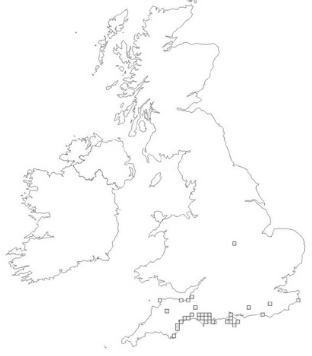
The bat group started a multi year project in 2024, with the aim of finding roost sites of Somerset rarest bat, the grey long-eared (GLE).
Initially as an experiment, we trap for grey long-eared bats in their typical habitat close to known records, and if we catch any, radio track them back to find their roost sites. Lots of volunteers will be needed for the radio tracking, and some for the trapping.
We also plan to radio track any GLE released from bat care.
The project is being led by Daniel Hargreaves under Fiona Mathews’s licence.
Project results
Success! Three male grey long-eared were trapped near Highbridge on 16th August 2024. Two of which were fitted with radio tags, and tracked.
We have had many trapping nights to get to this point, and lots of other interesting bats were caught on:
- Fri 17th and Sat 18th May 2024 at Montacute National Trust
- Fri 31th May 2024 – Montacute, National Trust
- Sat 1st June 2024 at Tintinhill National Trust
- Fri 2nd August at Dunster Castle
- Sat 3rd August at Holnicote Estate, Exmoor
- Fri 16th August – near Highbridge – 3 GLE caught, 2 tagged
- Sat 17th August – near Kewstoke
The hunt continues!
See all the 2024 results from our GLE project: https://somersetbat.group/bats/gle/2024-gle/
For more information, the BCT BatChat podcast episode recorded on our grey long-eared project (S6E59) at Tintinhull Gardens on 1st June, which was released in December 2024. Listen on this link below:
How to get involved
We plan to do trapping weekends using harp traps, mist nets and acoustic lures during both these periods:
- Latter part of May into early June
- Latter part of July and into August
We will set up a couple of hours before sunset, and trap for two nights with a small team of 6 to 8 people. As the sites will likely be really open, we will try to avoid full moon, when bat activity will be low. We also need a period of good weather before the sessions and a good forecast ahead to give the bats time to forage. We wouldn’t trap or track in periods of poor weather.
As we are likely to catch mostly other bat species, this will be great experience at bat ID and handling, especially for those planning to apply for licences. It’s likely to be popular so preference will be given to local members who can do some trapping and radio tracking dates.
If any GLE are trapped and tagged, then we will radio track them until we have located all their roosts, or their tags run out of battery/fall off (about 9 days).
- Most of the radio tracking will be done during the day to locate the roosts, and then, if possible, arrange to do emergence counts in the evening.
- If there are enough keen people, then night time tracking might show good foraging areas and night roosts.
For more details of the dates planned, and how to get involved, please see our events page: https://somersetbat.group/events/upcoming/
We need everyones help…
We have very few verified GLE records for Somerset (less than 30) with only a couple of roosts known. Hence if you have any GLE records please let us know by email : somersetbatgroup@gmail.com Ideally tell us:
- Where? (as detailed location as you can within any confidentiality restraints)
- How many? Sex?
- When? how often recorded?
- How verified? DNA? measurements? any photos?
As about half the records are within a km or two of the Somerset coast, we plan to focus our initial trapping in this area, from Porlock up the coast to Brean. We need help with identifying landowners so we can ask their permission. So if you know of any likely private landowners of unimproved pasture land with 2 km of the coast we would be very grateful for their contact details to somersetbatgroup@gmail.com
The grey long eared in Somerset
We have just under 30 records for GLE. These seem to fall into two rough “groups”.
- Somerset Coast from Dunster, Minehead, Hinckley, Cannington, Brent Knoll to Kewstoke in the North.
- In a band from Glastonbury down the A303 corridor Tintinhull, Montacute, Merriot to Chard.
Of the few of roosts identified, these are either very old records, or imprecise locations, and hence we plan to revisit and hopefully confirm them with DNA analysis.
About the grey long-eared bat
Grey long-eared bats (Plecotus austriacus) are very rare medium sized bats found only in a few places in southern England. It can be very difficult to distinguish the rare grey long-eared from the much more common brown long-eared bat (Plecotus auritus). Larger and greyer than the brown long-eared, sometimes confused with juveniles of the latter. Face often darker with a blackish mask.
The grey long-eared bat is a southern European species, with a distribution extending from the northern Mediterranean coast in the south to southwest England and the Black Sea coast in the north.
In England, grey long-eareds are restricted to a few colonies in Sussex, Hampshire, the Isle of Wight, Dorset, Devon and Somerset.
They tend to forage over meadows, grasslands, gardens and near forest edges, up to 6 km away from the roost. Their diet is Moths, Diptera mainly Tipulids – crane flies) and small beetles.
Links to more information: