Wow, May was a very busy month! Lots of bat box checks ongoing, and the return of our grey long-eared trapping and radio tracking project. Read all about it below!
In this May Bat Group Newsletter:
- Another grey long-eared caught and tracked at Glastonbury
- The spring round of Bat Box checks were very successful
- Bat Walk for Green Ilminster
- Our first Big Bat Count for a group in Axevale
- Join in Bat ID workshops from the NBMP
- Your next Bat Group events
- Training for working in confined spaces survey
- The latest BCT Bat Group Bulletin includes the latest species population trends from the NBMP
- A reminder that 2025 members memberships lapsed at the recent Annual Meeting
Grey long-eared project update
Our Grey Long Eared Project is back for another year, with a last minute trapping session organised in Glastonbury. Our new Treasurer Keith took part, and writes:
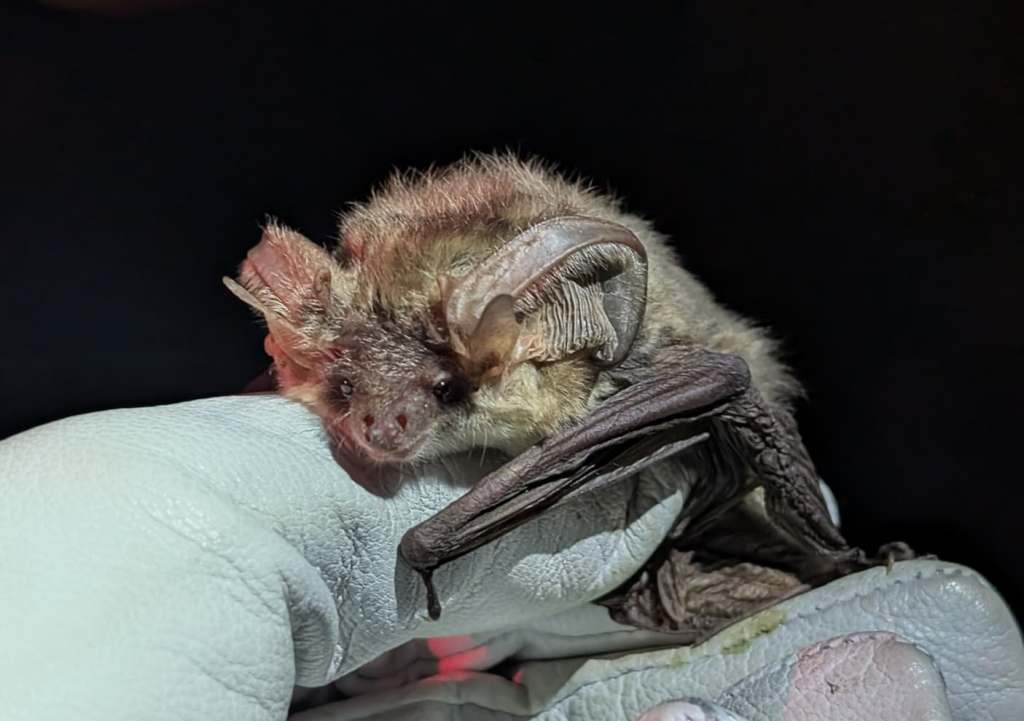
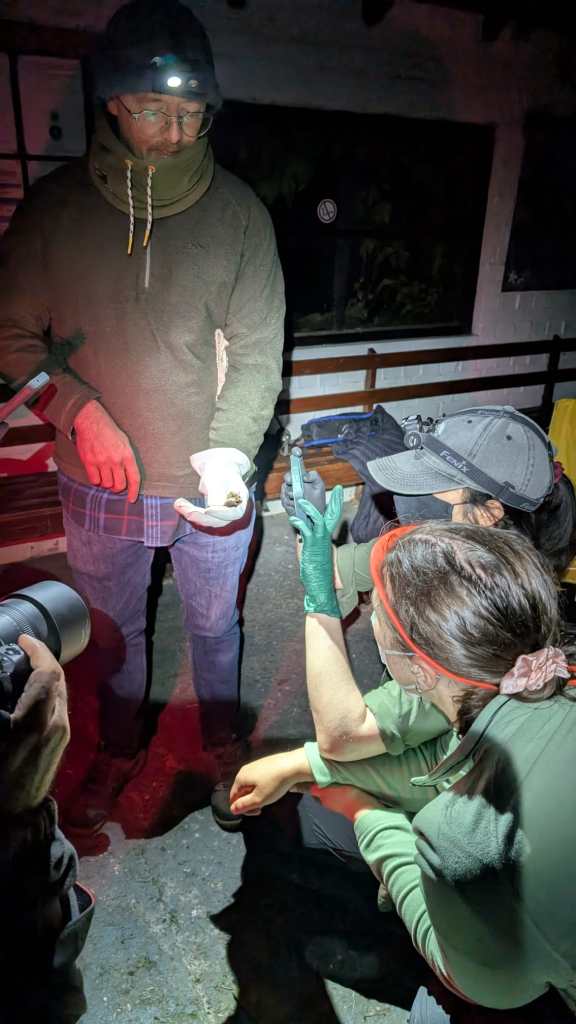
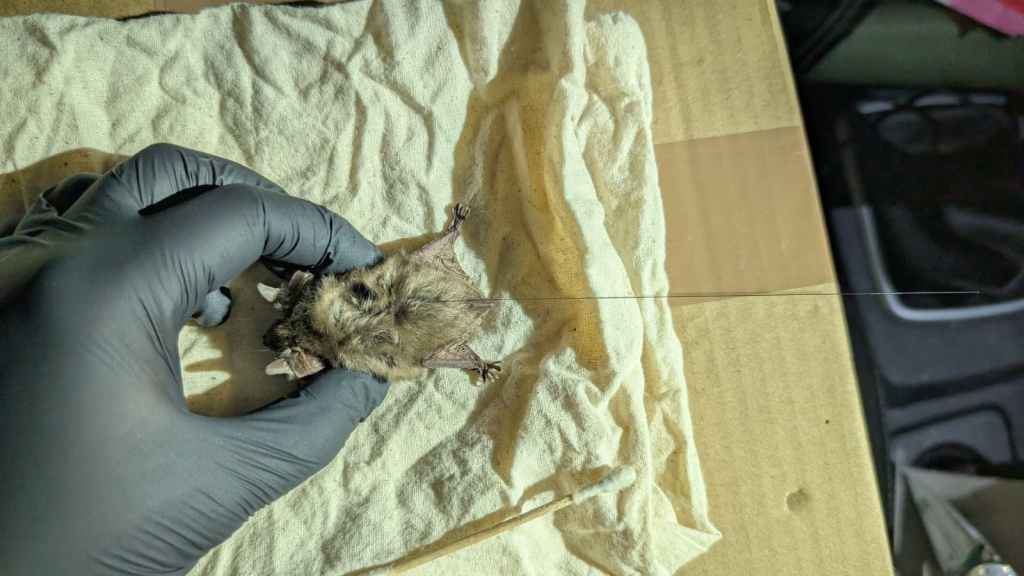
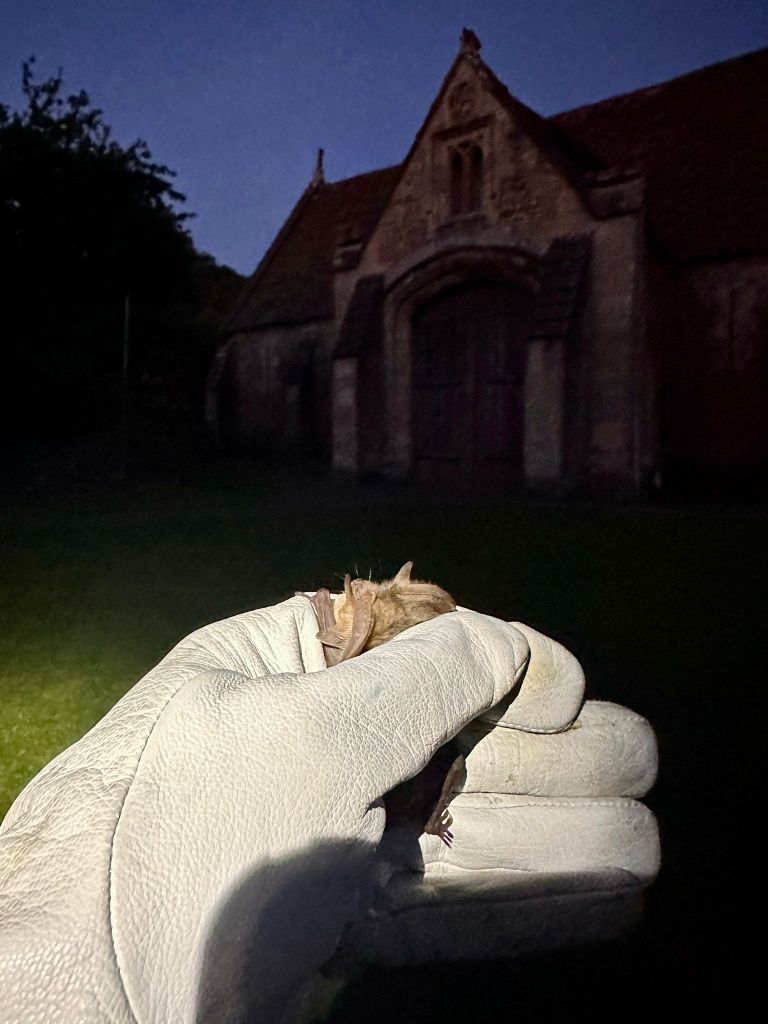
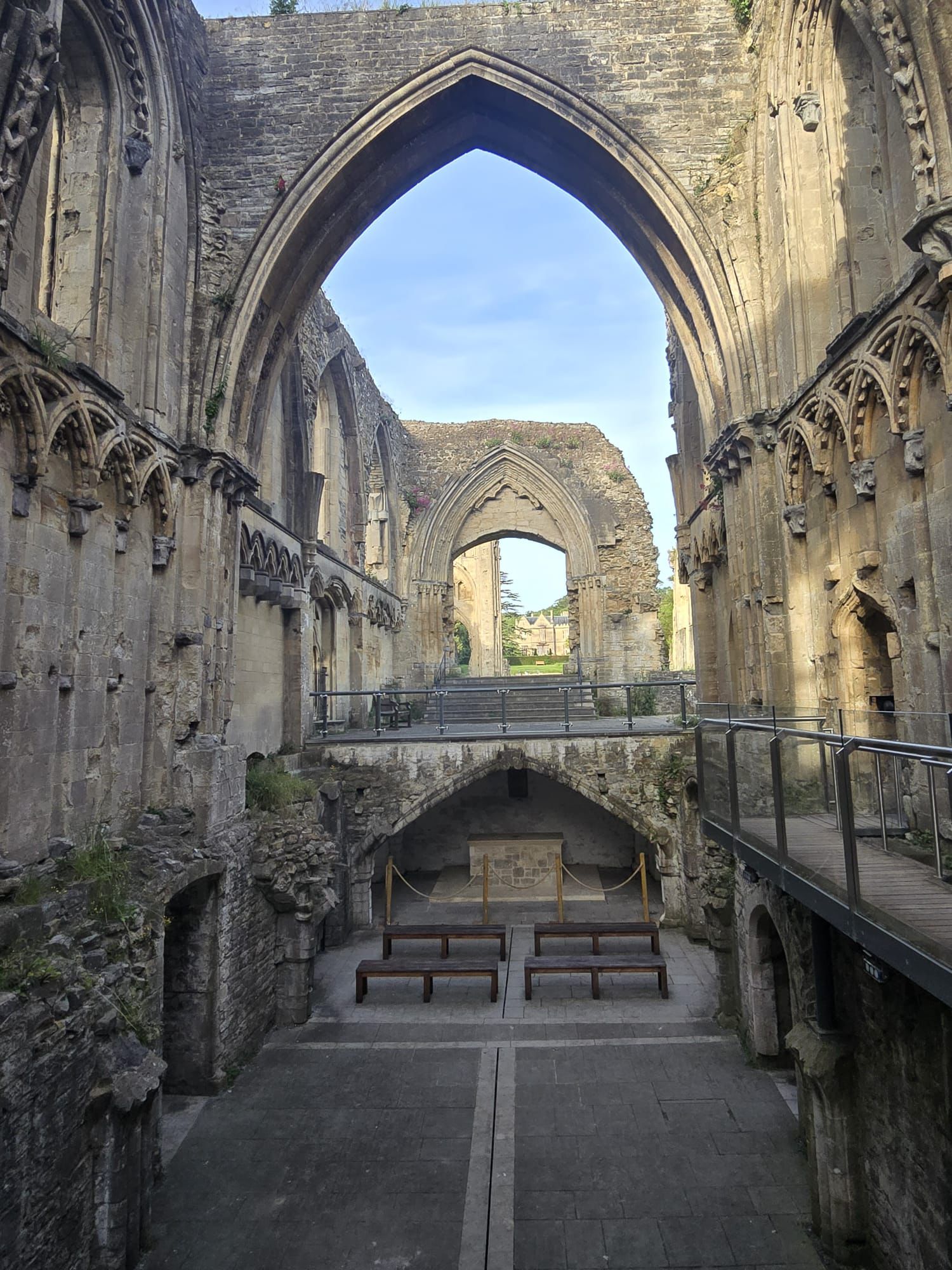
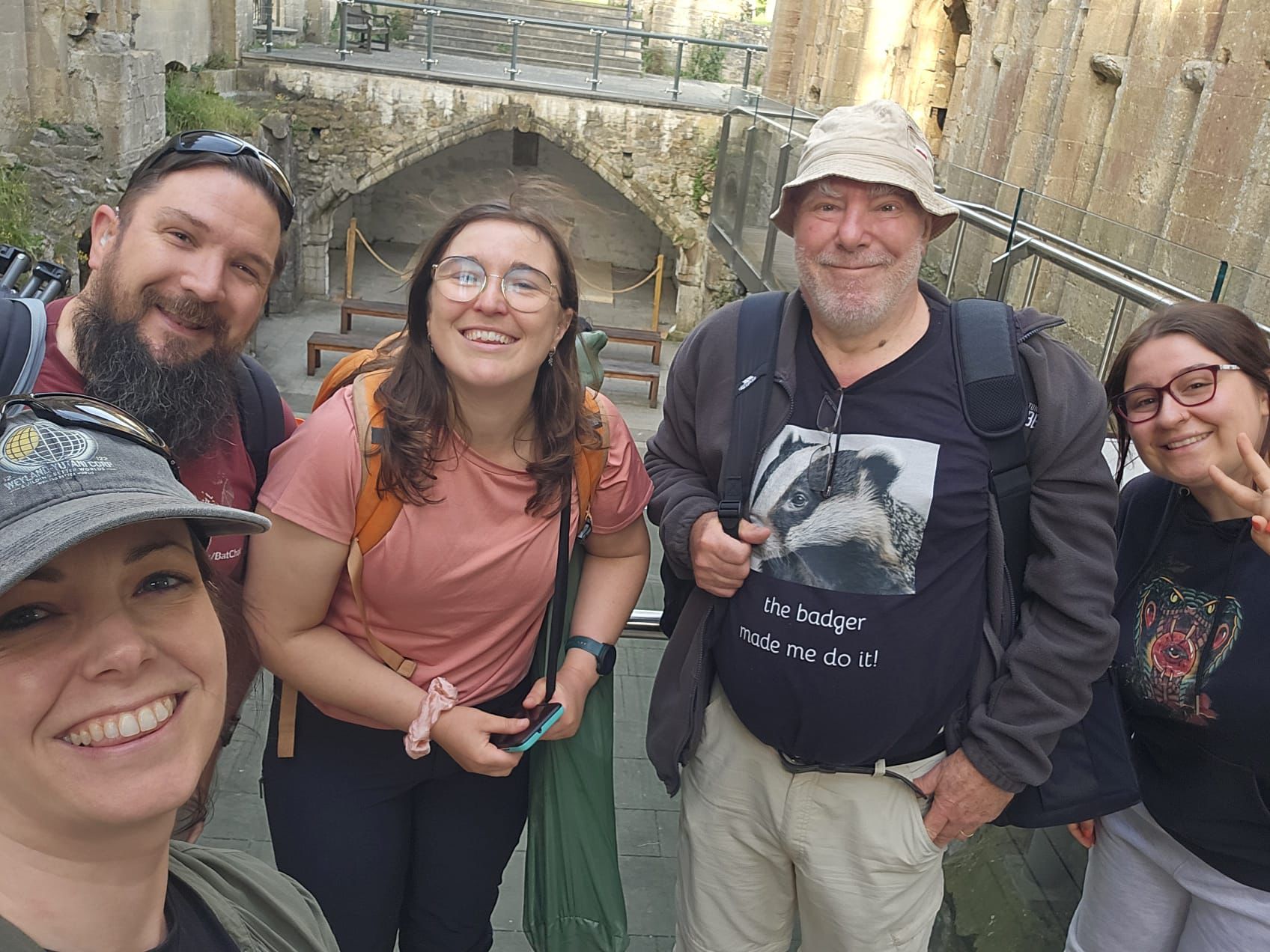
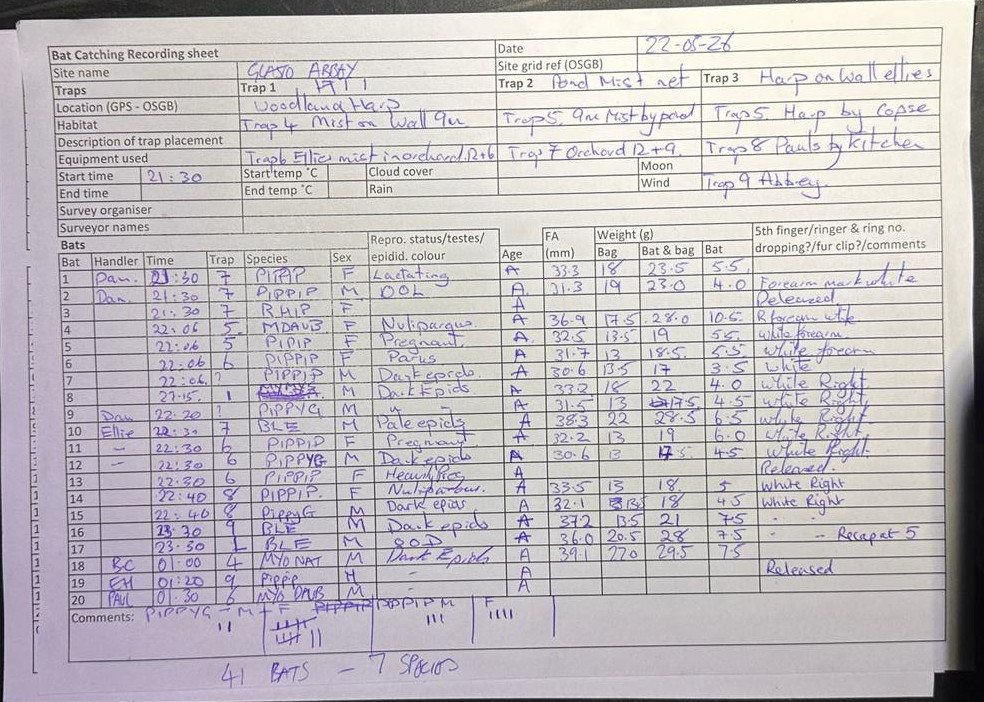
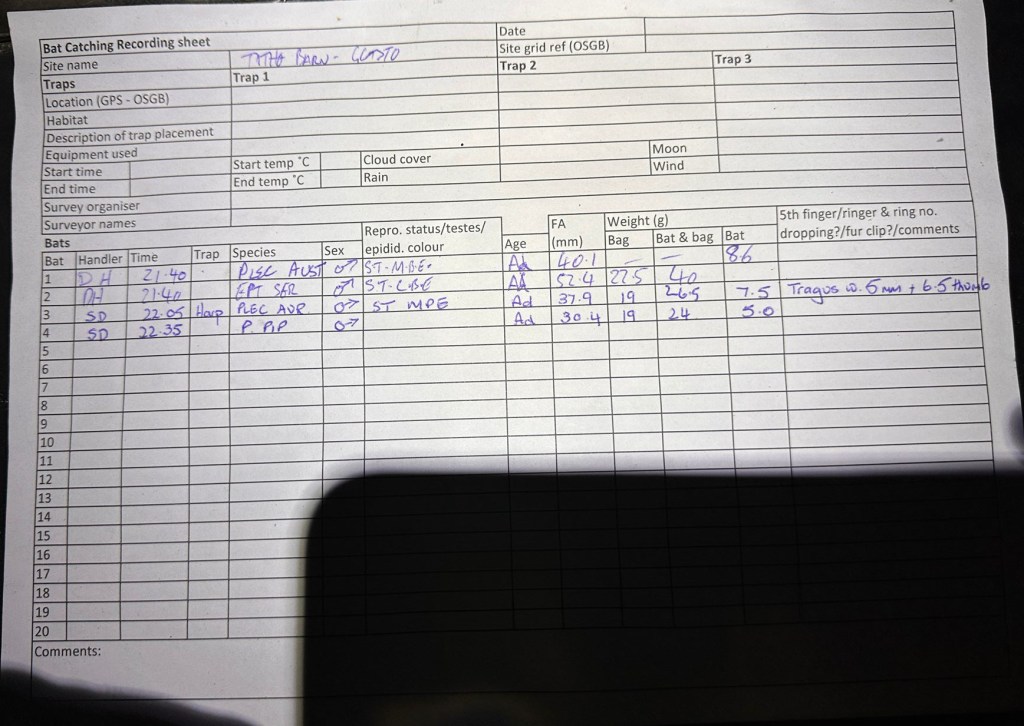
“On the 22nd & 23rd of May a team led by Dan Hargreaves & Ellie Hack with several volunteers from Somerset Bat Group & assistance from Glastonbury Abbey Wildlife volunteer team conducted bat trapping exercises. We used mist & harp nets, in the Abbey Grounds & close by as part of the Grey Long Eared project.
We trapped & recorded over 50 bats of 9 species over the two nights. On the second night this included one male Grey Long Eared Bat in the grounds of the Tithe Barn near the Abbey. As part of the project he was radio tagged and released and the team have been tracking him around Glastonbury every night since. He is very busy but does not seem to travel far on each outing, returning to the barn for a rest frequently. Click here to see a brief video of him being released with a radio tag attached.
Thanks to the team, and to the volunteers who came from as far as Cambridge, Tiverton & Newport to join us, for all the hard work, and to Glastonbury Abbey.”
We will be trapping, and hopefully tracking, Greys again latter on in the year, and hope to be able to share big news about this soon
Spring Bat Box Checks
May is traditionally the time when we check many of our bat boxes, (hopefully) just in advance of the pups arriving.
Sun 10th May – Levels bat box checks
Dani Smith led the checks of the bat boxes at Canada Farm, Shapwick and Catcott and said “Thank you to everyone who came to the checks, we did have some lively soprano pipistrelles and natterer’s in the boxes”.
Sat 16th May – Ham Wall bat box checks
The checks of the bat boxes at Ham Wall and Loxton’s Plot on the levels were led by Josh Butterworth.
At Ham Wall they found the usual soprano pipistrelles in the boxes, with two being maternity colonies of between 8 and 10+ females.
Ilminster Bat Walk – Thurs 28th May
Emma Baker was leading a group from “Green Ilminster” and reports:
“It was a beautiful evening for the first bat walk in Ilminster, and 27 people (and one dog) took part, walking along the Stop Line Way as the moon rose in a clear blue sky.
Using the Bat Group detectors, we heard (and saw) two noctules foraging around the tree tops, while soprano pipistrelles swooped low over our heads. The AutoID showed possible serotine and even barbastelle too. It was an excellent follow-up to Liz Walsh’s talk, and the Green Ilminster group is keen to do more for bats.”
Tues 12th May – Axevale Big Bat Count
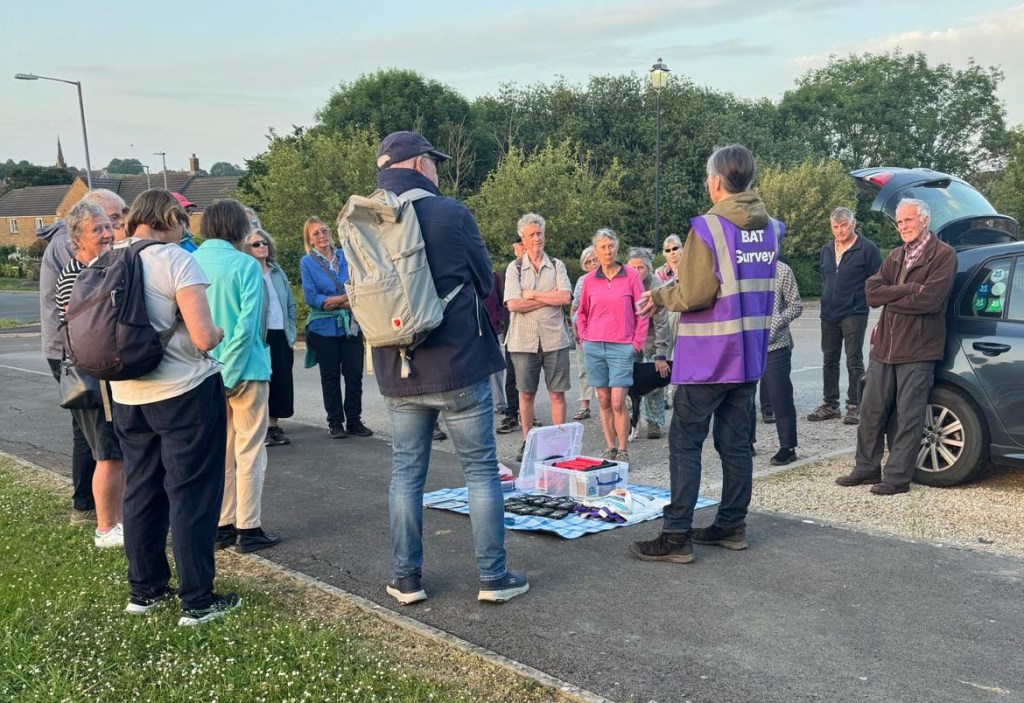
Around 21 people met in Cross Village Hall for a Big Bat Count organised by Axevale Climate Action.
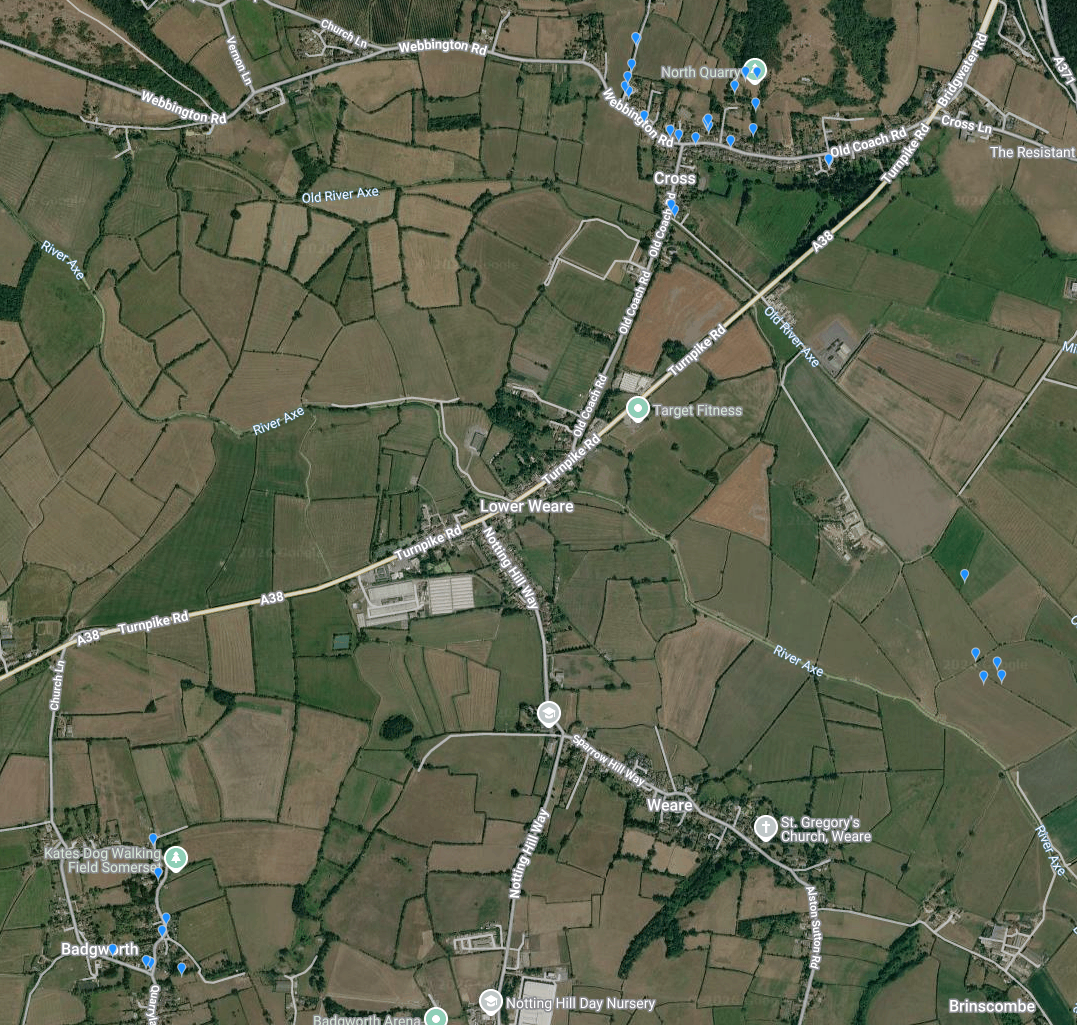
A chilly and quite windy night saw 5 teams head out to survey Cross and Badgworth. A total of 63 bat observations were made across 10 species, with Common Pipistrelle and Soprano Pipistrelle being the most frequently observed. There was one observation of Greater Horseshoe near North Quarry. The other 7 species observed will need more verification.
Initial unverified observations from the night of 12th May 2026 are in iNaturalist:
The recordings made on the night have now been downloaded and initial analysis done. There were a total 168 bat passes recorded across 7 species. The majority being Common Pipistrelle (40%) and Soprano Pipistrelle (36%). Serotine (8%) were also seen frequently. The remaining species were a small number of Noctule and Daubenton’s (2%), a possible Natterer’s, and lastly two recordings of Greater Horseshoes.
Bat ID Workshops
The NBMP team at the BCT sent us the following:
Join us for our bat identification workshops through the National Bat Monitoring Programme – last chance for these workshops this season!
Discover Your local Bats is a FREE introduction to bats in the UK and around the world and takes place online on Friday 29 May (6.30pm-8pm).
Waterside Echoes: Be A Bat Detective shows you how to use a bat detector to identify pipistrelles and Daubenton’s bats. Online on 5 June (£10-£3) and in-person with an outdoor practical session in Blairgowrie, Perthshire on 19 June (£16-£6).
Using Your Ears helps you use the ‘four elements of bat sounds’ to distinguish small and large bats. Online on 23 June (£10-£3), or in-person with a practical session outdoors on 11 June at Stotfold Watermill, Letchworth Garden City and Castle Douglas, Dumfries (£16-£6).
And don’t forget to choose your site(s) for the Field Survey (two visits in July) and Waterway Survey (two visits in August) by registering here. More information on taking part in the National Bat Monitoring Programme here.
The next Bat Group Events
There are lots of things planned, so come along and get involved! The next events are:
- Late May to early June – NBMP roost surveys
- Fri 5th June – Highbridge Big Bat Count
- Mon 8th June – Berrow Big Bat Count
- Sat 13th June – Shepton Beauchamp Big Bat Count
- Sat 20th June – Heal – Bat Detector Workshop
- Sat 27th June – Heal Rewilding Big Bat Count
- Sat 4th July – Bat Detector Building Workshop, Levels
- July – NBMP field surveys
- Sat 18th July – Otterhead Lakes Big Bat Count
- August – NBMP waterways surveys
Details of how to get involved for all events are on the website: https://somersetbat.group/events/
Training for working in confined spaces survey
BCT is currently looking at developing a confined spaces policy for bat groups and bat workers to follow, as we are aware of occasional incidences when site owners have stopped allowing bat groups to survey spaces such as tunnels until they have undergone confined spaces training.
The aim of this policy is to ensure that surveyors can assess risks related to confined spaces and take appropriate safety measures, and to reassure site owners that bat workers operating on their sites have access to appropriate guidance and training.
The definition of a confined space, as outlined in the Confined Spaces Regulations 1997, is:
“any place, including any chamber, tank, vat, silo, pit, trench, pipe, sewer, flue, well or other similar space in which, by virtue of its enclosed nature, there arises a reasonably foreseeable specified risk.”
For bat workers, this will mainly relate to carrying out hibernation survey work in tunnels and other areas that could fall under the definition of a confined space.
One step in this process is to gauge what training is already being required by site owners of bat workers in the UK when undertaking surveys in these spaces, and to what level.
If you are a bat worker/volunteer who carries out surveys or other activities in confined spaces, which has involved undertaking some form of confined spaces training, we would appreciate if you would take the time to complete a short survey relating to your experiences which can be found here: https://forms.gle/gWeZB7w21T8jpLo76.
Please submit any responses by 2 July 2026.
Thank you for your time in contributing towards the development of this guidance.
Best wishes, Dan Bryant, BCT Bat Groups Officer
Bat group bulletin
The latest BCT Bat Group Bulletin includes the news that the latest species population trends from the National Bat Monitoring Programme were published on Thursday 28th May.
All past editions of the Bulletin can be found on this page of our website:
Membership Renewal time
It’s the time of the year to think about membership of the bat group. There are currently:
- 61 members who last paid membership in 2025, and their membership lapsed at our annual meeting in April
We will send an email to each member detailing your current membership status, so please check your inbox (and spam).
It costs just £5 per household to rejoin the bat group (free for students/unwaged), and your renewed membership would then run until our April 2027 annual meeting, on 17th April 2027.
For regular members, you might like to consider taking out lifetime membership, which is just £50 per household.
Please pay your membership subs by BaCs or Paypal. Then:
- If your details have changed, then complete our online membership form to update your information.
- OR, if nothings changed, simply just drop us an email to let us know you have paid.
Full details on our website: https://somersetbat.group/join/